
Hello There?
My name is Jenna Samuelson.
I am an illustrative visual designer with a passion to bring client's visions to life. My skills in illustration, UX/UI design, and graphic design aid in creating high-fidelity design solutions, turning visions and concepts into stunning visuals.
Illustrations
In this section, you will see several miscellaneous illustrations I have worked on over the past few years—these range from personal projects to designed illustrations for academic classes. I work in both digital mediums such as the Adobe Suite (particularly Illustrator and Photoshop) and Procreate, as well as traditional mediums such as pen and paper.My style tends to lean towards a more anime-style influence with a focus on characters creation containing distinct yet simplified elements.
Digital Illustration Projects:


Graphic Illustration Projects:


UX/UI Design
In this section, you will see a multitude of UX/UI design projects I have worked on for my Fine Arts degree. I primarily work in the Adobe Suite (Illustrator, Photoshop, InDesign and After Effects) as well as Figma to create these composition. While I am trained in both, I will be focusing and highlighting more of the UI aspects of the process.
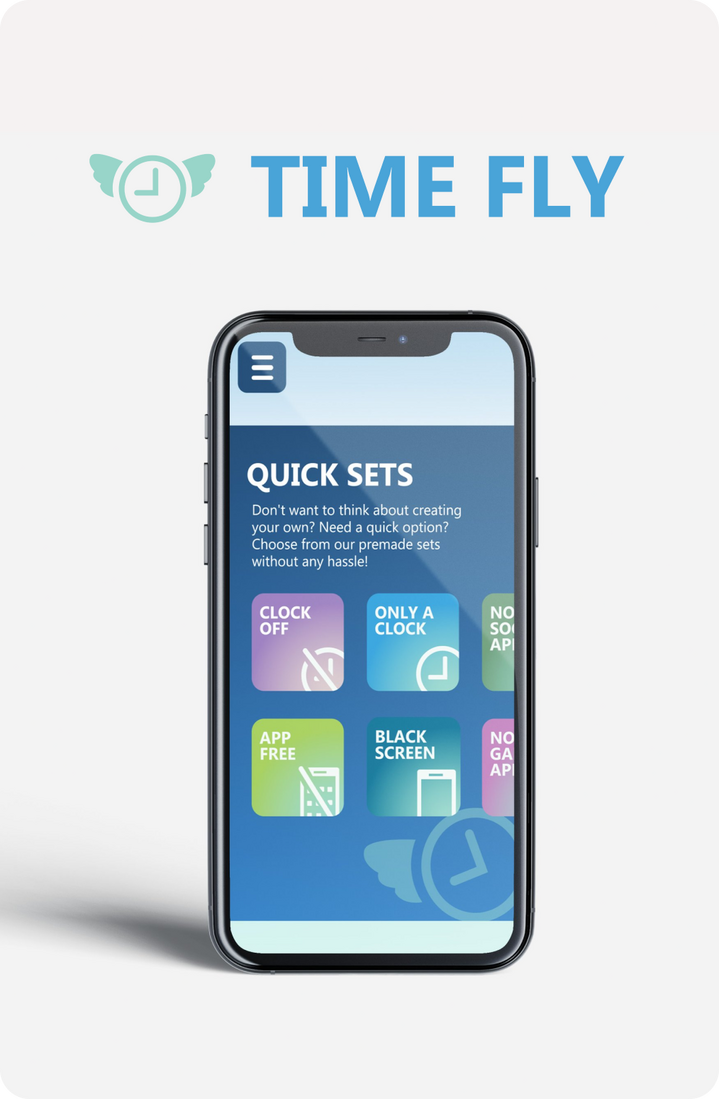
This secetion is under construction. Thank you for understanding.

Flexaplanner
(Adobe Creative Suite and Figma, 2023)
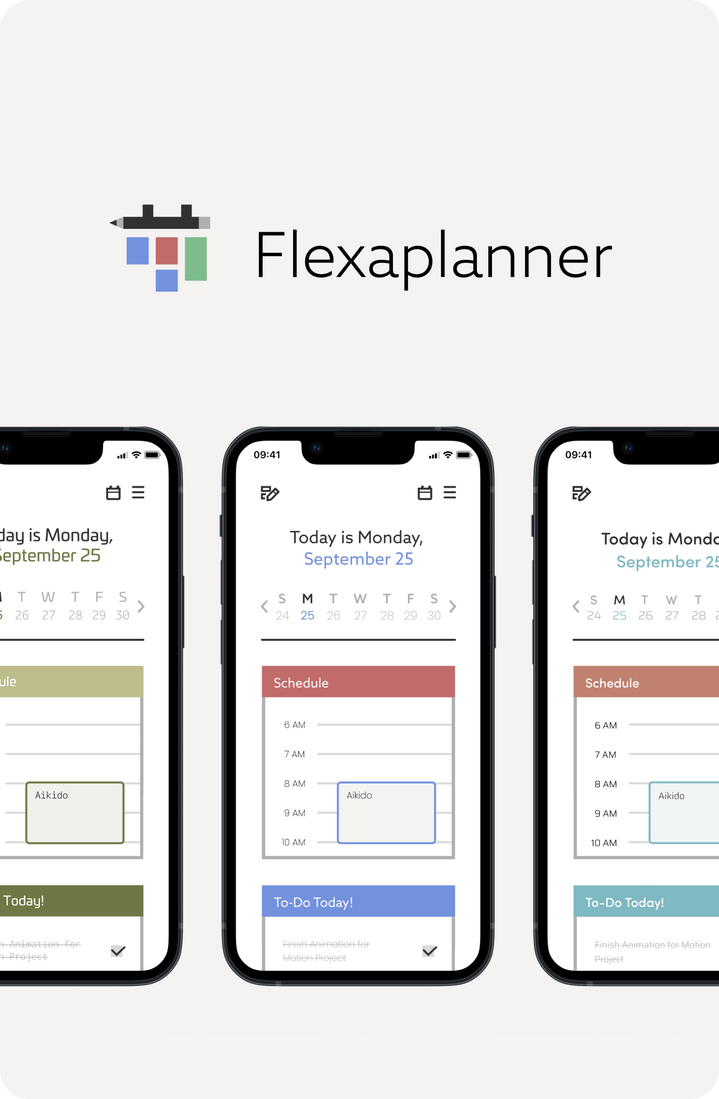
Flexaplanner is a fictional app concept dedicated to helping neurodivergent students manage their executive function skills in a less-rigged, more rigorous environment like post-secondary academics.College is not built with the neurodivergent and autistic individual in mind. An average undergraduate education demands that students take on large assignment loads while being as punctual and efficient as possible. This of course requires students to build and develop their own time-management system to ensure they fulfill their goals and balance their academic life with other activities.The user interface plays a massive role in the way neurodivergent individuals are all to navigate and succeed in completing tasks. In this project, I specifically focused on a customizable but neurodivergent-friendly interface system that can be changed to meet the individual’s preferences.(This project was created for CU Denver’s BFA Spring 2023 Thesis.)

Process Book (PDF):
Figma Prototype Link:
Research:
While designing a user experience or interface for an autistic individual may feel like it narrows the audience or accessibility, it does quite the opposite. Designing with physical and cognitive accessibility in mind is a crucial part of Universal Design, a set of principles that focus on creating a design that can be used by everyone. By designing with accessibility and flexibility, a design concept will become much more accommodating to not just these individuals, but may be enjoyed by all. For example, a neurodivergent accommodating design principle that aids with achieving the user’s objective may also benefit or provide a calming experience to a neurotypical individual as well.Simply having the choice to customize the type, size, or color of the interface not only includes and helps individuals on the spectrum navigate and meet their goals but may enhance the experience for a neurotypical individual as well.While no overall design system or interface its every autistic individual, there are also a couple of UI design areas that may generally increase an autistic individual experience with the app when customization is limited and are just good rules to meet for a larger neurodivergent audience.In my research, I focused on a few UI aspects that may hinder an autistic individual’s success when using an app. While customization is preferred, implementing these general presentational aspects increase usability for autistic individual and aid in the completion of their objectives. In the case of color, for example, designers should avoid using bright and intense hues for projects aimed towards individuals on the spectrum to prevent overstimulation when viewing and completing a task (see left example below). For information organization, visual or written blocks should be broken down into clear and differential segments to reduce confusion and distraction from completing their objective (see right example below). Additional visual factors, such type and animation can also play huge roles in how an autistic individual, and should be as subtle and straightforward without unintentionally causing distraction or overstimulation.
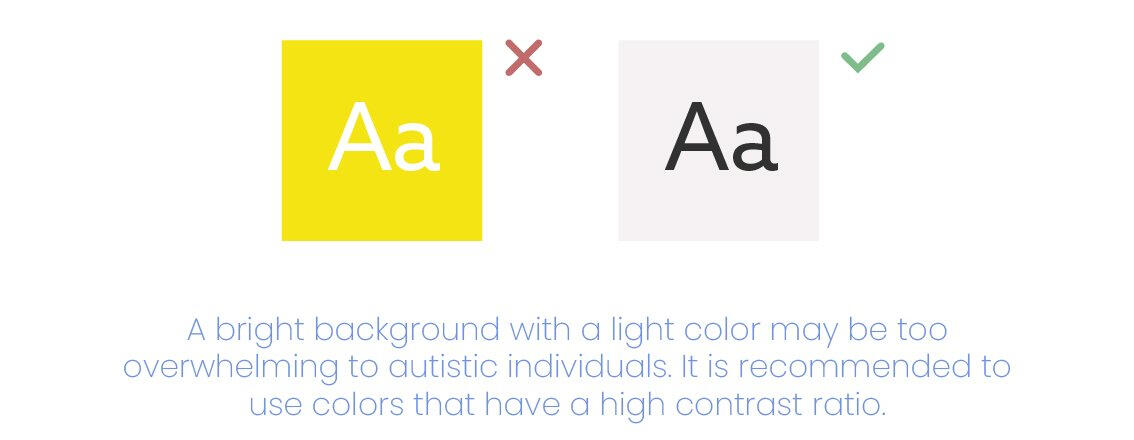
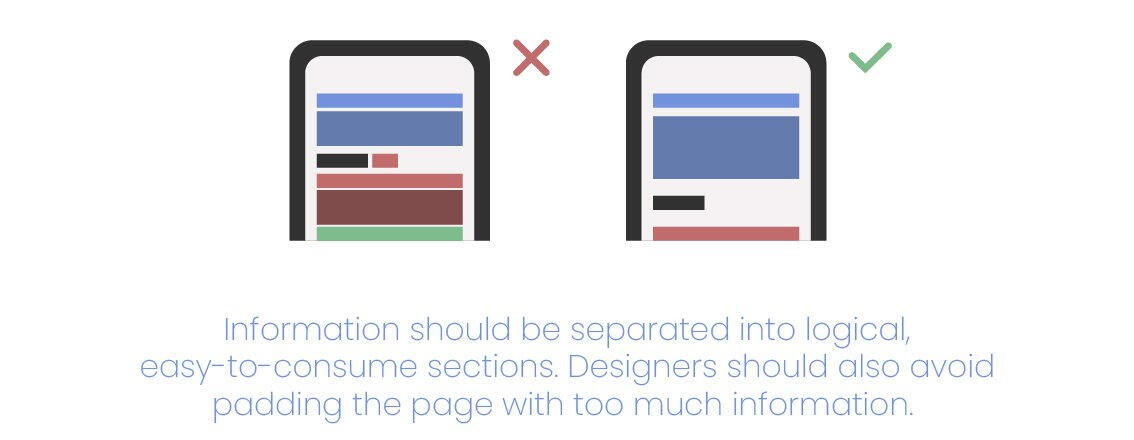
Above: Examples of UI design preferences for autistic individuals (Graphics were created for process book)
Competitive Analysis:
The following image details some potential competitors within the planner/time management app market. While this type of research tends to be used more for UX than UI, it is good to understand and take away some of the UI design choices that aid in the navigation of the app and contribute to the completion of the user’s objective.For this analysis, I tried to emphasize how the overall interface’s hierarchy and layout met the visual preferences of autistic individuals discovered in the previous section. Alongside this, I considered whether the visual choices would make the interface difficult to navigate and use in accordance with time management and organization tasks. (Ex. listing multiple tasks, crossing off a completed item, etc.)The four apps are broken down and labeled into their respective competitor types:
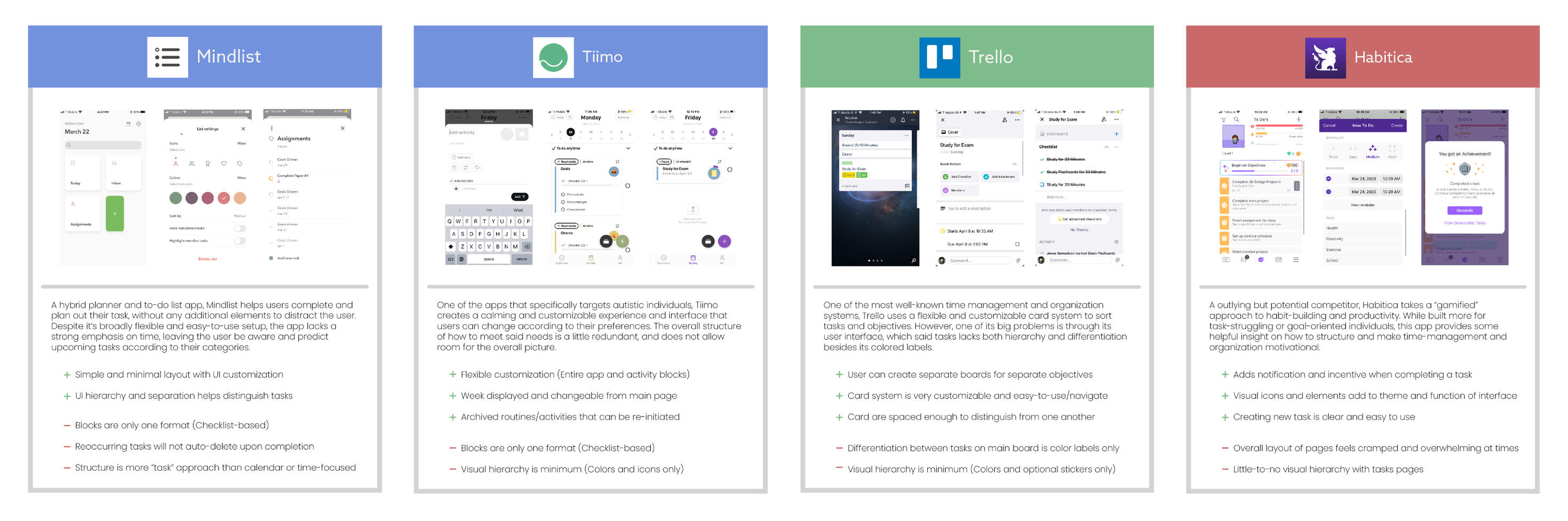
Blue: Direct Competitors, Green: Indirect Competitors, Red: Related Products
The preferences in each category indicate that autistic people may prefer certain visual design aspects within a user interface. However, said preferences should generally aid and add clarity to completing the task or objective at hand, not to distract or create complexity to the given task. The most important takeaway is that choice should be flexible and customizable to the preference of the individual whenever possible.Of course, understanding how Universal Design and accessibility can be implemented into UX/UI and design overall warrants future research. While I specifically focused more on user interface preferences for autistic individuals, it would be interesting to see if the same principles applied in the user experience or navigation/development low meet the autistic individuals’ needs and goals. In addition, further clarification may be needed on more areas of user interface design, particularly on what form of organization (ex. checklist or schedule) is preferred in the overall user experience. Understanding preferences and features that need to be implemented into the UX/UI ecosystem should continue to be investigated to create and advance Universal Design and build a world that allows autistic individuals to thrive and contribute. Creating a user interface that specifically works for and considers young and older autistic adults can help these individuals succeed in their tasks/objectives, like increasing executive function or meeting academic demands.
Style Development:


UI Style Guides/Mockup:


Reflections and the Future:
While I focused mostly on the visual interface of the Flexaplanner app, I believed that the navigation and flow were crucially important to the app’s foundations, just as much as its aesthetic and visual understanding. As I previously mentioned in the “Research” section, I will need to research, ideate, prototype, and test the interfaces and navigation flows and if they benefit or cause confusion for an autistic individual. In a future iteration, I would like to expand on the UX aspects of the app, how they may interact and benefit the UI, and how the app’s overall visual style and navigation could change to continue to appeal to and benefit the autistic/ASD community, particularly in a higher education setting such as college.Despite this, I learned quite a bit about how UI and visual design can play crucial components in creating a user experience that meets the needs of the autistic community. Universal design for all is crucial for meeting the needs of neurotypical and neurodivergent individuals, especially for those who may struggle in certain settings like post-secondary education.I would love to consider improving this concept in the future, as well as continue to focus on how UI design can meet the needs and preferences of autistic and neurodivergent individuals.
References:
(Please refer to the process book p.54-57 for full biography and references list. Process book link is at the top of the page under the demonstration video.)
Bird, Daisy. “Designing for people on the autism spectrum.” Scope. (February 1, 2022): https://business.scope.org.uk/article/designing-for-peopleon-the-autism-spectrum.Brown, Evan. “How to design visual learning resources for neurodiverse students.” Fullfabric. Accessed March 1st, 2023. https://www.fullfabric. com/articles/how-to-design-visual-learning-resources-for-neurodiverse-students.Dijkhuis, Renée, Leo de Sonneville, Tim Ziermans, Wouter Staal, and Hanna Swaab. “Autism Symptoms, Executive Functioning and Academic Progress in Higher Education Students.” Journal of Autism and Developmental Disorders 50, no. 4 (April 2020): 1353–63. https://doi.org/10.1007/ s10803-019-04267-8.Dijkhuis, Renee R, Tim B Ziermans, Sophie Van Rijn, Wouter G Staal, and Hanna Swaab. “Self-Regulation and Quality of Life in High-Functioning Young Adults with Autism.” Autism 21, no. 7 (October 1, 2017): 896–906. https://doi.org/10.1177/1362361316655525.Joury, Ari. “Autism Designs: How to Build Inclusive Products for People With Autism.” Builtin. (August 23, 2022): https://builtin.com/design-ux/ autism-designs.Pavlov, Nikolay. “User Interface for People with Autism Spectrum Disorders.” Journal of Software Engineering and Applications 2014 (February 11, 2014). https://doi.org/10.4236/jsea.2014.72014.Satpathy, Lalatendu. “Why designs to accommodate people with autism are better for everyone.” Medium. (August 28, 2020): https://uxdesign. cc/why-designs-that-accommodate-the-needs-of-autistic-people-are-better-for-everyone-dc5fb2144b15.“Key Considerations for User Experience for the Disabled.” Interaction Design Foundation. Accessed April 1st, 2023. https://www.interactiondesign.org/literature/article/key-considerations-for-user-experience-for-the-disabled.
Graphic Design
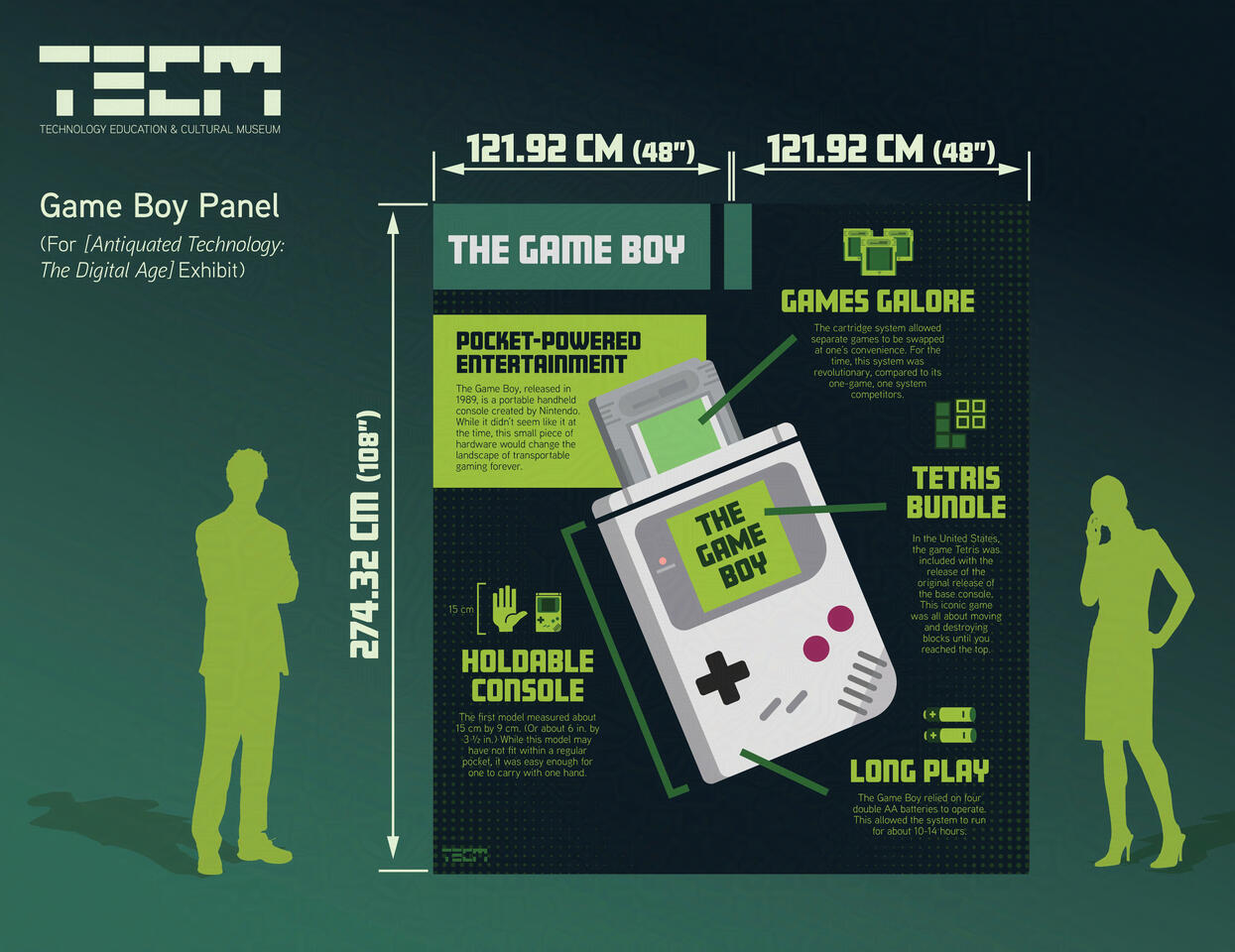
In this section, you see see a multitude of design projects I have worked on for class projects and freelance contract work in the last few years. I primarily work in the Adobe Suite (Illustrator, Photoshop, InDesign and After Effects) to create these composition.
Graphic Design Projects with Process Descriptions:

Misc. Graphic Design Projects:


About Me

Jenna Samuelson is a visual designer who integrates her combined knowledge of traditional art and digital design to help visualize solutions for client needs.Jenna's passion for creating and visualizing started in early elementary school and continued to be a consistent part of her years since. While throughout those early years she wanted to pursue a path in illustration or comic creation, it became less feasible and anxiety-producing to lead a path solely off of creating visual compositions in an extremely completive market. However, Jenna discovered the potential of design during her final years in high school through Warren Tech, a technical secondary school. This would still allow her to create and visualize ideas in a practical and demanding setting.This rising interest and passion in design continued after those two years, becoming the sole focus of her higher education pursuits in digital design and minor in illustration at the University of Colorado-Denver. As she begins to enter the workforce, Jenna hopes to demonstrate and contribute effective and pixel-perfect client solutions and outcomes using industry-standard programs such as the Adobe Creative Suite and Figma.You can usually spot Jenna wearing a flat cap and sports-themed gear, reading, doodling or going to the library to acclimate greater knowledge in design, art, and Japanese culture.